
What Should a Kayak Jet Motor Kit Include?
Use a workbench hardware close-up to build an itemised kayak motor-kit enquiry covering the propulsion unit, mounting, controls and power equipment.
Watch the steering and mounting hardware close-up
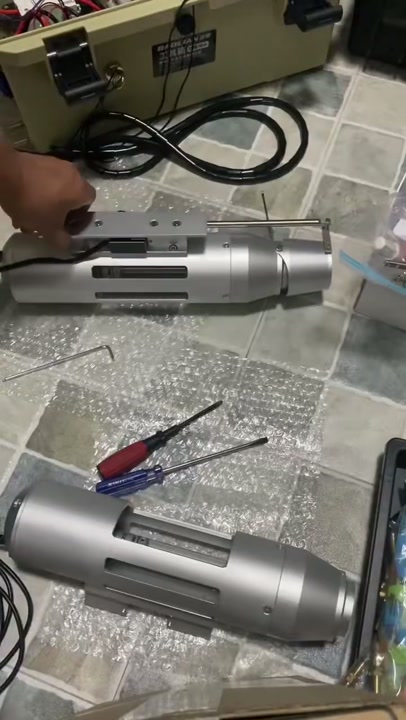
Use this workbench scene to identify the components to include in an itemised kit discussion. It does not show a kayak installation.
What to look for
- Two assembled thrusters are shown together.
- Side-mounted linkage and mounting hardware are visible.
- Cables are shown alongside the outer housings.
The example units do not establish a standard kit list, battery inclusion, measured performance or compatibility with your kayak.
0:20 · Supplier demonstrationTwo similar-looking thrusters can represent different supply arrangements. For a distributor or outdoor shop, the useful comparison is the complete quoted configuration: what is included, what needs to be added and which kayak it is intended for.
The linked supplier clip shows assembled waterjet thrusters, steering linkage, mounting hardware and cables on a workbench. Use those visible components to organise an itemised kit enquiry.
In this guide
What does this hardware clip show, and what is still missing?
Two assembled thrusters are shown together, with side-mounted linkage, mounting hardware and cables visible. Their layout helps identify the components to ask about when requesting a quotation.
The scene does not define a standard package. A case, remote or battery shown in any other product photograph should also be checked against the itemised quotation. For resale, keep the package description tied to the selected configuration.
What belongs on an itemised kit list?
The word kit does not settle the contents. A package with a thruster, motor, ESC and enclosure differs from a propulsion-unit-and-motor option for integration. Ask for a written list with each item's reference and supply status.
| Item to list | Question for the quotation |
|---|---|
| Propulsion unit and motor | Which exact unit and motor are proposed? |
| ESC and enclosure | Are these included, optional or customer supplied? |
| Steering actuator and linkage | Which parts belong to this nozzle configuration? |
| Remote, receiver and control equipment | Which compatible versions and connections are required? |
| Mount, fasteners, cables and connectors | What is supplied for the proposed installation? |
| Battery and charger | Is each included, optional or to be sourced separately? |
Will the proposed mounting layout suit the kayak?
Start with the kayak's make, model, hull construction and intended mounting location. Request a dimensioned drawing for the propulsion unit and attachment, then compare it with photographs and measurements of that area.
A fin box, rudder fitting or existing motor mount needs its own interface review. Ask about the inlet and outlet locations, hull clearance, access for removal and space for any nozzle movement. Include carrying and storage in the discussion rather than checking only the unit's overall length.
Can an existing battery or remote be reused?
For a battery already available, provide its model, nominal voltage, capacity, continuous discharge rating and connector details. Ask for a review against the proposed motor and ESC together. A capacity figure alone does not establish electrical compatibility or operating time.
For controls, provide the remote and receiver references and request a connection diagram. Clarify how thrust and direction are commanded. A fixed-nozzle configuration still needs an agreed way to direct the kayak; a steerable one needs the relevant actuator and controls.
How should you compare quotations for batch purchasing?
Give each quotation the same application brief and request separate lines for the selected unit, mounting equipment, controls and power equipment. State the trial quantity, possible batch quantity and destination so the responses address the same purchasing scope.
Ask which drawings, connection information and operating documents are available for the proposed version. Also ask how replacement-part references and future component changes would be identified. These questions help a shop or distributor keep its customer-facing package description consistent with the order.
What evidence should support a pilot order?
Identify the unresolved questions before moving from a hardware photograph to a trial configuration. These might concern the attachment drawing, component compatibility, control behaviour or the equipment required to complete the installation.
If performance figures are needed, request the exact configuration and documented test conditions, including the craft, battery, load and water conditions. The workbench clip does not establish speed, thrust, operating time or suitability for a particular kayak.
What should you send with a kayak motor-kit enquiry?
A useful brief connects the actual kayak with the proposed package and purchasing scope. Use the response to compare included components and outstanding requirements before discussing a larger order.
- Kayak make, model, construction and intended use.
- Mounting-area photographs and relevant measurements.
- Approximate paddler and equipment load.
- Battery and control references already available, plus steering preference.
- Requested package or integration scope, quantities and destination country.