
Which Parts Make Up a Waterjet Thruster?
Learn how to turn a close-up of housings and loose components into a labelled parts enquiry without guessing material grades, assembly scope or interchangeability.
Look at the housings and loose components
Use this supplier overview to identify the component you want to discuss, then request a confirmed part reference.
What to look for
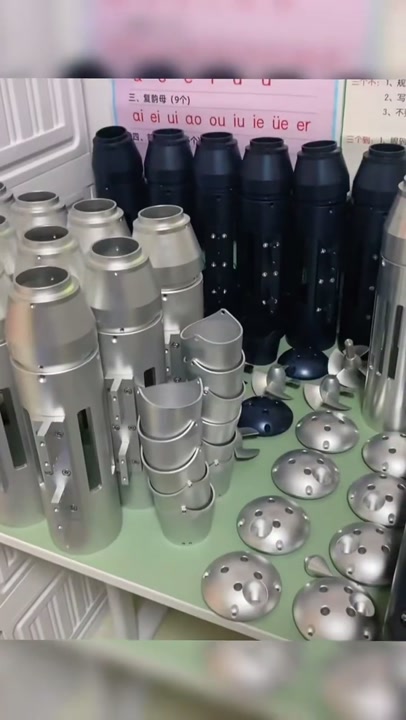
- Several cylindrical housings and shorter loose components are arranged on a table.
- Both silver-colored and dark-finished housings are visible.
- Some close-ups reveal internal guide-like features and openings in the outer housing.
The footage does not confirm material grade, a standard kit list, stock availability or compatibility between similar-looking parts.
0:15 · Supplier demonstrationA table of waterjet components can look informative while leaving the most important purchasing question unanswered: which of these parts belong to the unit in your quotation? The supplier close-up shows several housings and loose pieces, with both silver-colored and dark finishes visible.
This guide focuses on identification. A labelled photograph, matching drawing and itemized parts list can turn that visual overview into a useful discussion about a complete assembly, integration components or a replacement part.
In this guide
Which parts can you distinguish in the footage?
The camera passes over rows of cylindrical housings, shorter cylindrical pieces and round components with holes. Some openings reveal internal guide-like features. A closer view also shows a long outer housing with side openings and parts placed beside it.
Use those visible shapes to point out the item you mean. Avoid assigning an exact function or part number solely from its position on the table; several components or revisions may look similar from one angle.
Can color or finish establish the material specification?
A silver-colored surface and a dark-finished surface distinguish appearances in the clip. They do not identify an alloy grade, coating process, wall thickness or suitability for a particular water environment. Reflections and lighting also affect how the surface looks.
Ask for the material and finish specification of the selected part, with the required supporting documentation identified in the quotation. Keep that request linked to a part reference rather than applying one visible finish to every component in the video.
How do you connect a visible shape to a part reference?
Mark the relevant component on a still image and ask for its confirmed name, part number and drawing revision. For a loose item, include views of both ends and any connection features. State whether it comes from equipment you already have or from a new configuration being considered.
The following records help prevent a conversation about one part from becoming a quotation for another similar-looking item.
| Record to request or provide | What it establishes |
|---|---|
| Annotated image of the selected item | The visible component under discussion |
| Confirmed part name and identifier | A common reference for the quotation |
| Dimensioned drawing and revision | The specified geometry and interfaces |
| Assembly reference or equipment identification | The configuration to which the part belongs |
| Material, finish and supply-status confirmation | What is proposed for delivery |
Does a group of components define a complete kit?
Parts displayed together do not establish that they are supplied together. Ask whether the offer covers a bare housing, a mechanical assembly, a motorized propulsion unit or a package with controls and power equipment. Each scope needs its own itemized list.
For distributors, use that list to prepare customer-facing package descriptions. Accessories, fastening hardware, cables and control equipment should have a stated inclusion status, rather than being inferred from adjacent products in the footage.
What makes a replacement-part enquiry different?
A replacement request should identify the existing assembly before a substitute is proposed. Provide the available model reference, original order information and photographs of the part in context. Include the relevant interface measurements or drawing if available.
Ask for written confirmation of the proposed replacement and any associated components it requires. Matching outer appearance alone does not settle fit or interchangeability, especially when the original revision is unknown.
How should quantity and repeat supply be discussed?
Separate an initial evaluation quantity from the expected repeat requirement. Ask which part references and document revisions will appear on the quotation and order records, and how later changes would be communicated.
Rows of parts in a workshop clip are not a current stock list or a delivery commitment. Request availability, lead time and any minimum quantity for the exact assembly or spare you need.
Ask about an identified part or assembly
Prepare an enquiry draft that connects the item in the image to your intended supply scope. An identifiable component and its application are more useful starting points than a general request for the parts shown in a video.
- Annotated component image and available part or assembly reference.
- New-build or replacement purpose, including existing equipment details.
- Relevant dimensions and required material or finish documentation.
- Requested assembly scope, evaluation quantity and repeat requirement.